
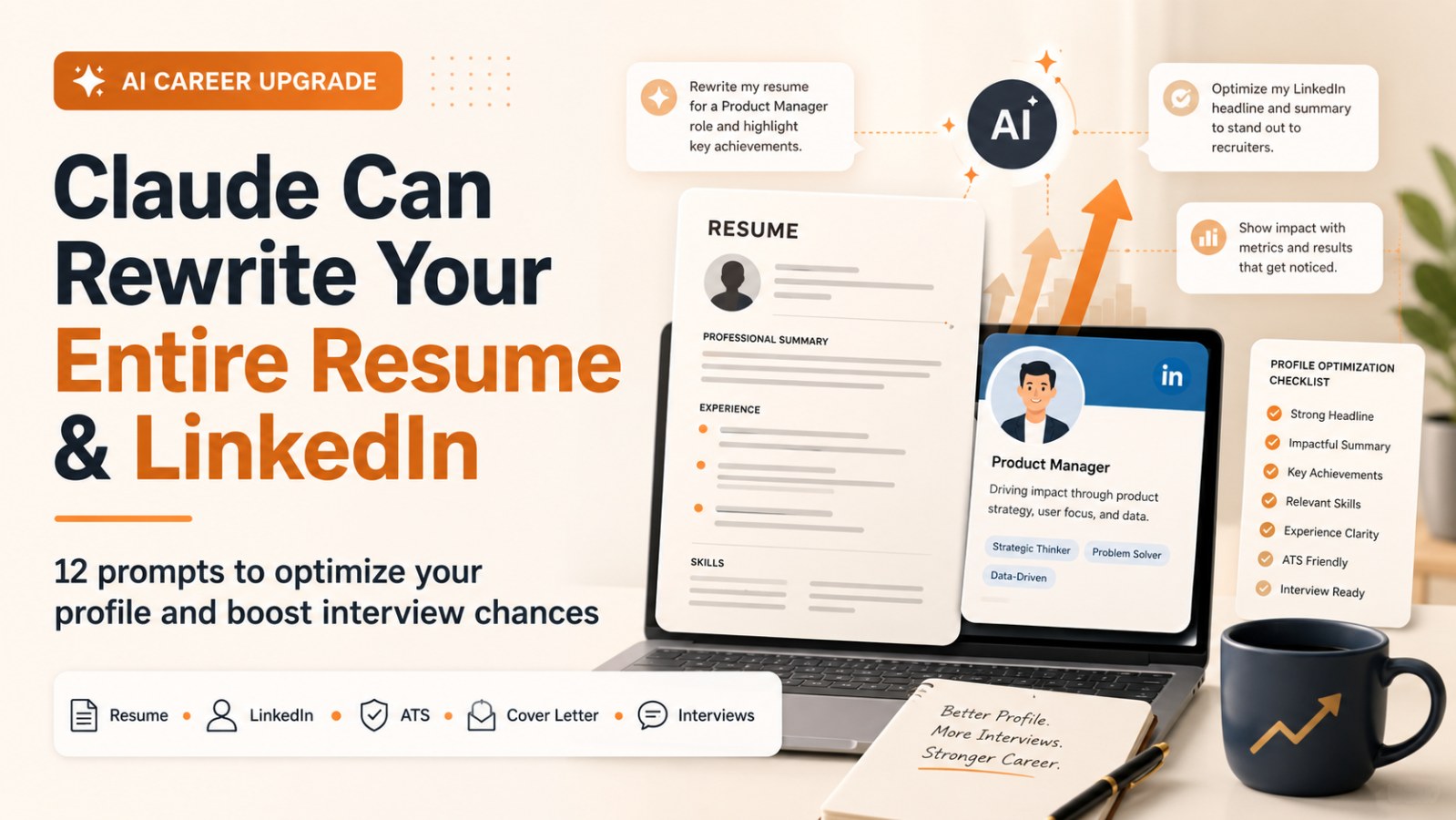
12 Claude Prompts to Improve Your Resume, LinkedIn Profile and Interview Chances
Discover 12 Claude prompts to optimize your resume, beat ATS filters, improve LinkedIn, write better cover letters, prepare for interviews, negotiate salary and build a job search system.
Claude is no longer just a tool for rewriting a few resume bullets to “sound better.”
Used properly, Claude can become a professional job search assistant. It can read job descriptions, analyze hiring requirements, optimize your resume for ATS systems, write stronger cover letters, improve your LinkedIn profile, prepare you for interviews, handle career gaps, support salary negotiation and help you build a disciplined job search system.
In other words, Claude does not only help you write job application materials.
It helps you reposition yourself in front of recruiters.
To be clear, no prompt can guarantee that you will receive interview invitations in seven days. Results depend on your experience, the job market, the role, competition and how consistently you execute. But strong prompts can help you improve your application materials faster, more clearly and more strategically.
Anthropic’s prompt engineering guidance emphasizes clarity, examples, structure and output control. These principles matter even more when you use Claude for strategic work such as resumes, LinkedIn profiles and interviews.
Here are 12 Claude prompts you can use to upgrade your entire job search system.
Why Use Claude for Resume and LinkedIn Optimization?
Most candidates only edit their resume at the surface level:
- Replace a few verbs
- Make the summary sound more professional
- Add a few keywords
- Change the template
- Rewrite the cover letter politely
Those things help, but they are not enough.
A strong application profile must answer five questions:
- Who are you?
- What are your strongest capabilities?
- What measurable results have you created?
- Why are you a strong fit for this role?
- Can a recruiter see your value in the first few seconds?
Claude can help with all five if you provide the right data: your current resume, target job description, real achievements, standout projects, metrics, career goals and job search direction.
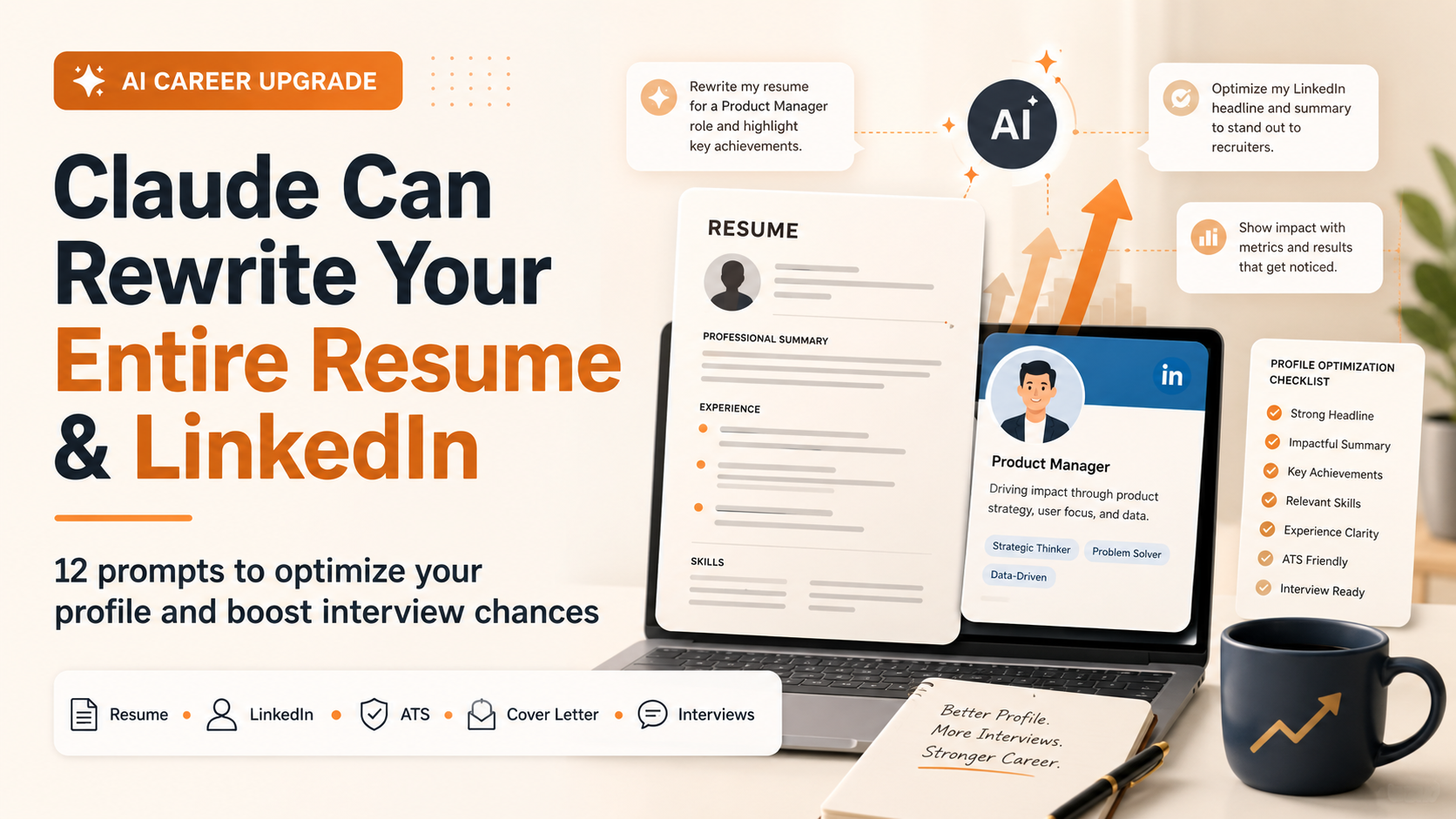
1. The 6-Second Recruiter Resume Rewriter
Recruiters do not read every resume carefully from top to bottom at first glance. They scan quickly to decide whether to keep reading.
This prompt helps Claude rewrite your resume so the most important value appears immediately.
You are a senior technical recruiter who has reviewed tens of thousands of resumes.
Rewrite my resume to make a strong impression in the first 6 seconds.
Requirements:
- Rewrite the Professional Summary in 2–3 powerful sentences
- Convert bullet points into this structure: Achieved [result] by [action], creating [measurable impact]
- Add specific metrics wherever available
- Replace weak verbs like “helped”, “assisted”, “worked on” with stronger verbs
- Remove unnecessary content, outdated skills and unrelated work
- Improve visual hierarchy so recruiters can scan quickly
- Identify the 3 weakest bullets and rewrite them
Input:
Current resume: [PASTE RESUME]
Target job description: [PASTE JD]
When to use it
Use this when your resume is too long, too generic or focused on responsibilities instead of results.
2. ATS Resume Optimizer
Many companies use Applicant Tracking Systems before a recruiter reads your resume. If your resume lacks the right keywords or has formatting issues, it may never reach a human.
Prompt:
You are an Applicant Tracking System optimization consultant.
Optimize my resume for this target job description.
Requirements:
- Extract important keywords from the JD
- Add keywords naturally into Summary, Experience and Skills
- Include both acronyms and full terms when useful
- Standardize headings: Summary, Experience, Skills, Education
- Remove ATS-unfriendly formatting such as tables, icons, text boxes, complex headers and footers
- Standardize date format
- Estimate ATS match score from 1–100
- Create a keyword match report: keyword, where it was added, and why it matters
Input:
Current resume: [PASTE RESUME]
Target JD: [PASTE JD]
Important note
Do not keyword-stuff. Your resume must still read naturally and reflect your real experience.
3. Achievement Quantifier
Many resumes are weak not because the candidate lacks experience, but because the achievements are written too vaguely.
Weak example:
“Worked on customer management system.”
Stronger version:
“Implemented a customer management system serving 15,000 users, reducing internal request handling time by 30%.”
Prompt:
You are a strategy consultant who turns work experience into measurable achievement statements.
Rewrite each resume bullet into a quantified achievement.
Focus on:
- Revenue impact
- Cost savings
- User, customer, transaction or data scale
- Time saved
- People managed or cross-functional leadership
- Growth metrics
- Reduction in bugs, complaints or errors
- Processes or systems built
For each bullet, create a table:
1. Original bullet
2. Weakness in the current bullet
3. Rewritten quantified version
4. Questions to ask me if data is missing
Input:
Current bullets: [PASTE BULLETS]
Usage tip
If you do not have exact metrics, ask Claude to generate questions that help you recall reasonable, truthful data. Do not invent numbers.
4. Cover Letter That Actually Gets Read
Weak cover letters often begin with:
“I am writing to apply for…”
It is polite, but easy to ignore.
A stronger cover letter connects the company’s needs, your experience and the value you can create.
Prompt:
You are a Senior Recruitment Director who reads hundreds of cover letters every week.
Write a cover letter that makes a hiring manager want to keep reading.
Requirements:
- Do not start with “I am writing to apply for”
- Open with a hook connected to the company’s problem or goal
- Mention evidence that I researched the company
- Highlight 3 specific skills that match the JD
- Include one quantified achievement
- State one initiative I could contribute in the first 90 days
- Keep it between 250–300 words
- Mark which sentences should be customized for each company
Input:
Job description: [PASTE JD]
Company information: [PASTE INFO]
Resume or experience summary: [PASTE INFO]
5. LinkedIn Profile Transformer
LinkedIn is not just an online resume. It is where recruiters search for candidates by keywords, titles and skills.
A strong LinkedIn profile needs:
- A clear value-driven headline
- A narrative About section
- Achievement-based Experience section
- Featured proof of work
- Searchable skills
- Consistent activity strategy
Prompt:
You are a senior executive recruiter who sources candidates on LinkedIn.
Optimize my full LinkedIn profile to attract recruiters.
Requirements:
- Write a headline using: [Title] | [Specialty] | [Value Proposition]
- Rewrite the About section into 3 engaging sections
- Rewrite Experience as achievement-based storytelling
- Suggest 3–5 items to pin in Featured
- Select 50 relevant skills for my target role
- Add recruiter search keywords
- Suggest a recommendation strategy
- Suggest a professional LinkedIn banner
- Create a 30-day LinkedIn visibility plan
Input:
Current LinkedIn content: [PASTE]
Target role: [PASTE ROLE]
6. Career Pivot Repositioner
If you are changing industries or roles, your resume should not make you look like an outsider. The goal is to translate your existing experience into the language of the new field.
Prompt:
You are a career transition coach who helps professionals move into new industries.
Reposition my resume for this new role or industry.
Requirements:
- Extract transferable skills from my current experience
- Translate old industry language into target industry language
- Reframe achievements from the perspective of the new industry values
- Identify 2–3 skill gaps
- Suggest certifications, projects or portfolio work to close the gaps
- Rewrite the professional summary for the career pivot
- Write a 30-second career change story
- Sync the LinkedIn headline with the new direction
Input:
Current role: [PASTE]
Target role: [PASTE]
Reason for change: [PASTE]
Current resume: [PASTE]
7. Interview Preparation Kit
A strong interview is not just about answering questions. It is about proving that you understand the company, the role and your own story.
Prompt:
You are a senior interview coach preparing candidates for high-stakes roles.
Create an interview preparation kit for this position.
Include:
- 10 important things to know about the company
- Breakdown of the JD into 5 core competencies
- 10 STAR stories for leadership, conflict, failure, teamwork, innovation and customer focus
- A 90-second “Tell me about yourself” script
- A strong “Why this company” answer
- A framework for “Greatest weakness”
- A script for handling salary expectation questions
- 5 smart questions to ask the recruiter
- 7 interview mistakes to avoid
- A 24-hour thank-you email template
Input:
Company: [PASTE]
Role: [PASTE]
Job description: [PASTE]
My resume: [PASTE]
8. Salary Negotiation Strategy
Many candidates lose money because they accept the first offer or negotiate only the base salary instead of the full package.
Prompt:
You are a compensation consultant who helps candidates negotiate offers.
Build a salary negotiation strategy for this offer.
Analyze:
- Market salary range for this role, experience level and location
- Total compensation: base salary, bonus, equity, signing bonus, benefits and PTO
- My leverage points
- Counter-offer script
- Email response to the offer
- What to negotiate if base salary cannot increase
- Walk-away threshold
- Phrases to avoid during negotiation
Input:
Job title: [PASTE]
Company: [PASTE]
Current offer: [PASTE]
Experience: [PASTE]
Desired salary: [PASTE]
Competing offer if any: [PASTE]
9. Company Values Resume Aligner
At many top companies, technical skills are not enough. They also look for cultural fit.
Prompt:
You are a recruiter at a major technology company evaluating both capability and cultural fit.
Align my resume with the target company’s values.
Requirements:
- Identify 5–8 core values or leadership principles of the company
- Map each resume bullet to the value it demonstrates
- Identify values that are not yet represented
- Write 3–5 new bullets from real experience to fill the gaps
- Rewrite the professional summary to show cultural fit
- Annotate each bullet with the value it proves
Input:
Company: [PASTE]
Company values / leadership principles: [PASTE]
Current resume: [PASTE]
Target JD: [PASTE]
10. Career Gap and Red Flag Neutralizer
Career gaps, layoffs, short tenures and career pivots are not automatically weaknesses. They just need to be explained well.
Prompt:
You are a talent acquisition partner who evaluates non-linear career paths fairly.
Help me address red flags in my resume.
Include:
- Reframe career gaps as purposeful development periods
- Explain layoffs honestly and professionally
- Present short tenure as a strategic step
- Position career change through transferable skills
- Consolidate freelance work into a consulting portfolio if appropriate
- Reduce age bias by optimizing older experience
- Remove low-confidence language like “just”, “only”, “although”
- Create interview scripts for each concern
Input:
My concern: [PASTE]
Current resume: [PASTE]
Target role: [PASTE]
11. Job Search Operating System
Effective job searching should not depend on luck. You need a system.
Prompt:
You are a job search strategist who helps candidates reduce time-to-interview.
Build me a job search operating system.
Include:
- A list of 30–50 target companies
- Keyword filters for job alerts on LinkedIn, Indeed, Glassdoor and niche job boards
- Application tracking spreadsheet structure
- A 60-minute daily job search routine
- Warm outreach strategy
- Referral request template
- How to use LinkedIn Easy Apply effectively
- Recruiter DM template
- Which jobs deserve deep customization and which can be applied to quickly
- A 30-minute Friday weekly review process
Input:
Target role: [PASTE]
Industry: [PASTE]
Location: [PASTE]
Hours per week for job search: [PASTE]
12. Recruiter Outreach and Referral Prompt
A strong resume is not always enough. Many opportunities come from messaging the right person, in the right way, at the right time.
Prompt:
You are a recruiter outreach strategist.
Create networking and referral messages to increase my interview chances.
Include:
- LinkedIn connection request under 300 characters
- Follow-up message after they accept
- Message asking about an open role
- Polite referral request
- Email to a hiring manager
- Follow-up message after 5 days
- Versions for recruiter, hiring manager, alumni and industry peer
- Sentences to avoid because they sound too generic or desperate
Requirements:
- Concise
- Respectful of the reader’s time
- Not pushy
- Clear reason why I fit
- Light CTA
Input:
Target role: [PASTE]
Target company: [PASTE]
Relevant experience: [PASTE]
Reason I am interested: [PASTE]
A 7-Day Claude Workflow to Improve Your Job Search
Day 1: Prepare your data
Collect your current resume, target job descriptions, LinkedIn profile, standout projects and measurable achievements.
Day 2: Rewrite your resume
Use prompts 1, 2 and 3 to rewrite your resume, optimize it for ATS and quantify your achievements.
Day 3: Improve LinkedIn
Use prompt 5 to rewrite your headline, About section, Experience section and 30-day activity plan.
Day 4: Write custom cover letters
Use prompt 4 to create tailored cover letters for specific companies.
Day 5: Build the job search system
Use prompt 11 to create your application tracker, target company list and daily routine.
Day 6: Start outreach and referrals
Use prompt 12 to message recruiters, hiring managers, alumni and industry peers.
Day 7: Prepare for interviews
Use prompt 7 to create your interview prep kit, STAR stories and follow-up email templates.
Common Mistakes When Using Claude for Resume Writing
Claude can help a lot, but avoid these mistakes:
- Inventing metrics or exaggerating experience
- Using one resume for every role
- Keyword-stuffing for ATS
- Making LinkedIn sound exactly like your resume
- Sending generic cover letters
- Not checking spelling, numbers and dates
- Letting Claude guess instead of giving real data
AI helps you present yourself better. But the foundation must still be real experience and a clear strategy.
Conclusion: Claude Will Not Replace Your Job Search, But It Can Make It More Strategic
Claude is not magic, and it cannot guarantee interview invitations in seven days.
But it can help you do in seven days what many candidates delay for months: rewrite your resume, optimize for ATS, improve LinkedIn, write stronger cover letters, prepare for interviews, build a job search tracker and message recruiters more effectively.
The real difference is not whether you use AI.
The difference is whether you use AI as a quick writing tool or as a complete job search system.
If you are preparing for your next role, start with the first prompt: rewrite your resume for the first six seconds.
CTA
Choose one role you truly want, paste your current resume and the job description into Claude, then apply these 12 prompts step by step. Do not just ask Claude to “make my resume better.” Use it to build a clearer, more strategic and recruiter-friendly job search system.
FAQ 1: Can Claude help write a resume?
Yes. Claude can help rewrite resume summaries, improve bullet points, quantify achievements, align experience with a job description and make the resume easier for recruiters to scan. However, all information should be based on real experience.
FAQ 2: Can Claude optimize a resume for ATS?
Yes. Claude can extract keywords from a job description, suggest where to place them naturally and identify formatting issues that may affect ATS parsing. You should still review the final resume carefully before submitting.
FAQ 3: Can Claude improve my LinkedIn profile?
Yes. Claude can help rewrite your LinkedIn headline, About section, Experience section, skills list and content strategy. It can also suggest Featured section items and recommendation request templates.
FAQ 4: Can Claude help prepare for interviews?
Yes. Claude can help create STAR stories, answer scripts, company research summaries, role competency breakdowns, recruiter questions and follow-up email templates.
FAQ 5: Should I use the same AI-generated resume for every job?
No. You should customize your resume for each target role. A strong resume should reflect the job description, company priorities and the most relevant parts of your experience.
FAQ 6: Is it safe to let Claude create metrics for my resume?
Claude can suggest where metrics are needed, but you should not let it invent numbers. Use real data, reasonable estimates you can explain, or ask Claude to generate questions that help you recall accurate metrics.