
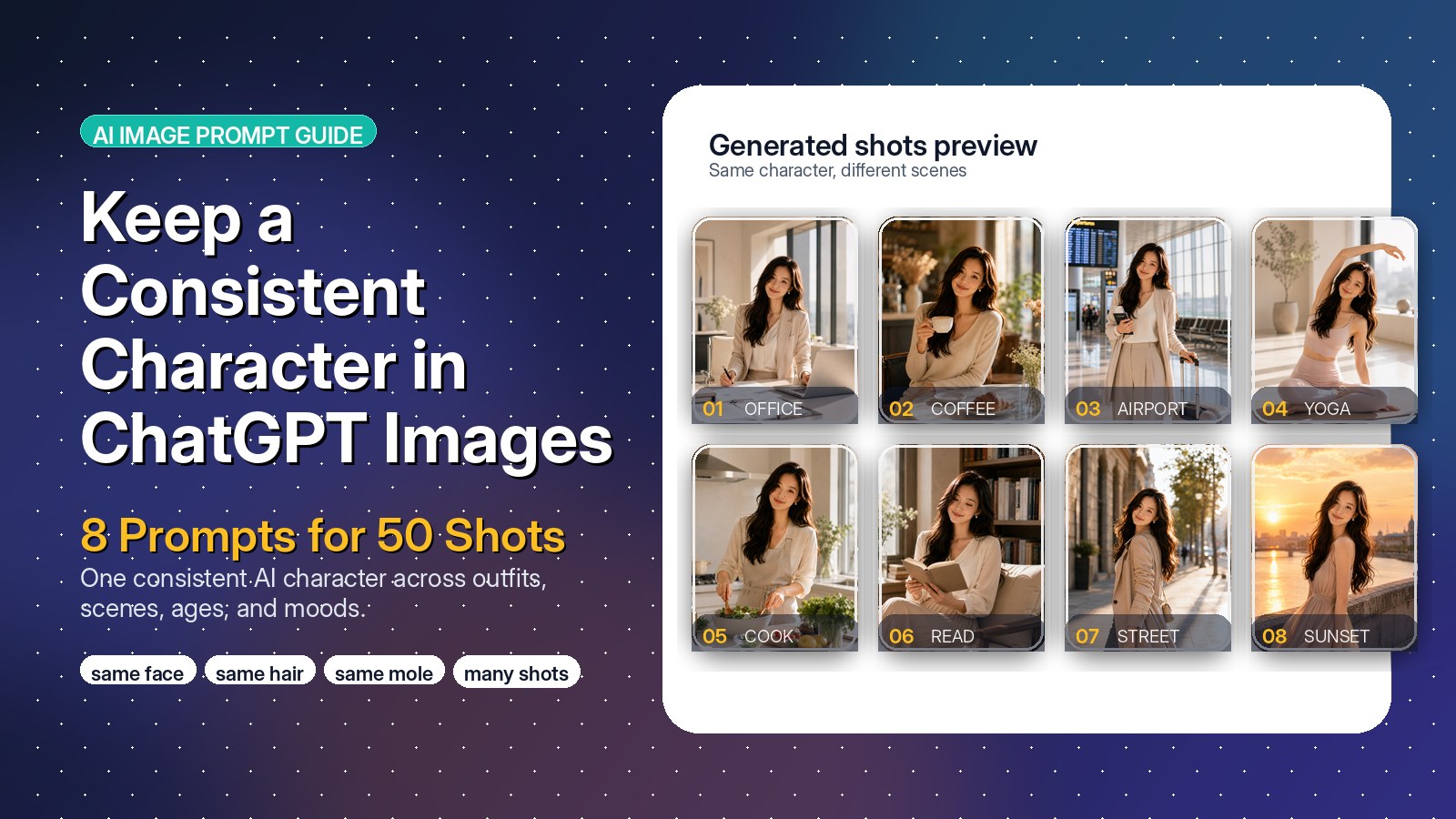
Keep a Consistent Character in ChatGPT Images: 8 Prompts for 50 Shots
slug_en: consistent-character-chatgpt-image-generation
You generate a great-looking character in the first image, but by the second one the face has changed, the hair color shifted, and the build looks like a different person entirely. This is the classic problem of consistent character ChatGPT image generation. The good news: you don't need model fine-tuning or complex tooling — just an 8-prompt workflow in the right order to produce 50 images where the character stays one single person.
This guide gives you 8 ready-to-use prompts, when to apply each, and why every step works. It's written for ChatGPT (GPT Image), and most of the principles carry over to other image models too.
Why ChatGPT keeps "drifting" the character
Image models have no perfect visual memory. Every render re-interprets your description through words — if the description is vague, each pass yields a different version. Two main causes:
Not enough identifying detail: "a brown-haired girl" leaves the model millions of valid ways to draw her.
No re-anchoring between turns: each new prompt is treated as if starting from scratch.
The fix is to lock the character with a detailed base profile, then reference that profile in every later image. That single idea runs through all 8 prompts below.
8 prompts for consistent character ChatGPT image generation
1. Build the base character profile
This is the foundation that defines the character from the start. The more detailed the description, the higher the consistency across images.
Create a detailed profile for a single character. Clearly describe gender, age,
height, face, hairstyle, hair color, eye color, build, clothing style, and
recognizable features. Keep all of these traits unchanged in every image
generated later. Present it as one complete, consistent description.
Use when: starting any new character. Save the profile ChatGPT returns — it's the character's "ID card" that you'll reuse constantly.
Sample prompt:
Create a detailed profile for ONE single female character:
- Gender & age: female, around 24–26 years old.
- Ethnicity: Asian (East/Southeast Asian), naturally fair, smooth skin.
- Height & build: about 168cm, slender, well-proportioned, feminine figure.
- Face: oval shape, delicate cheekbones, harmonious features, a soft alluring smile.
- Eyes: large, deep brown, expressive gaze.
- Hair: long to the mid-back, black with a slight brown tint, soft loose waves, voluminous.
- Style: feminine, elegant, subtly glamorous, modern fashion sense.
- Distinguishing marks: a small beauty mark near the corner of the lips, naturally thin eyebrows.
Keep ALL of these traits unchanged in every image generated later. Present it as one complete, consistent description suitable for safe-for-work (SFW) content.
2. Lock the identifying features
Once you have the profile, instruct the AI to preserve all of it before each new set.
Use exactly the character created earlier. Keep the face, build, hair color,
hairstyle, expression, and overall recognizable style unchanged. Do not alter any
personal feature. Only change the setting and action as I specify in the
following images.
Use when: before each new batch, so the AI keeps tracking the original character instead of "re-inventing" it.
Sample prompt:
Use exactly the female character created above.
Keep the face, deep brown eyes, long wavy black-brown hair, slender figure, the beauty mark near the lips, and the feminine–elegant style unchanged.
Do not alter any personal feature.
Only change the setting, outfit, and action as I specify in the following images.
Keep all content tasteful and safe-for-work (SFW).
3. Generate a story-driven image sequence
Create a sequence of 10 consecutive images that tell a story. The main character
must keep every identifying feature. Each image is a different scene. The scenes
must connect logically so the viewer follows the storyline from start to finish.
Use when: designing comics, storytelling content, or illustrated scripts for social media.
Sample prompt:
Create a sequence of 10 consecutive images telling a story about the defined female character: a day in her city life (waking up, going for coffee, working, an evening stroll at sunset, night).
Keep every identifying feature unchanged.
Each image is a different scene, logically connected so the viewer follows the story from start to finish.
Cinematic style, beautiful lighting.
4. Change outfits, keep the identity
Use the defined character. Create 10 versions with different outfits. Keep the
face, hairstyle, build, and recognizable style unchanged. Only change clothing
and accessories. Make sure viewers easily recognize it's the same character.
Use when: building fashion sets, product showcases, or multiple visual styles.
Sample prompt:
Use the defined female character.
Create 10 versions with different outfits: áo dài, an elegant evening gown, a business set, streetwear, a beach maxi dress, a winter knit, etc. Keep the face, hairstyle, build, and recognizable style unchanged. Only change the clothing and accessories.
Outfits should be tasteful and flattering.
Make sure viewers easily recognize it's the same character.
5. Place the character in different spaces
Use the same character. Create scenes one by one in an office, a coffee shop, an
airport, a park, a shopping mall, and a library. Keep all identifying features
unchanged. Only change the location and activity to fit each setting.
Use when: building personal or brand imagery across varied backdrops.
Sample prompt:
Use the same female character. Create scenes one by one in: an office, a coffee shop, an airport, a park, a shopping mall, and a library.
Keep all identifying features unchanged (face, long hair, build, beauty mark). Only change the location, outfit, and activity to fit each setting.
Natural lighting, beautiful composition.
6. Build a social media image bank
Create 20 different images of the same character. Each image shows a distinct
emotion or activity. Keep the identifying features consistent across the whole
set. The images should suit social platforms and personal content.
Use when: you need a rich source of images to post consistently over a long period.
Sample prompt:
Create 20 different images of the same female character.
Each image shows a distinct emotion or activity (bright smile, pensive, selfie, drinking coffee, reading, walking the street, doing yoga, cooking, etc.). Keep the identifying features consistent across the whole set.
Feminine, charming style, suitable for Instagram/Facebook (SFW). Vertical 4:5 frame for social media.
7. Simulate the character across life stages
Use the same character. Create versions at different stages of life. Keep the
core identifying features. Show plausible age-related changes while still letting
viewers recognize it as the same person.
Use when: telling the story of someone's growth or building life-stage content.
Sample prompt:
Use the same female character. Create versions at different stages of life: a young woman at 18, at 25, at 35, and at 50. Keep the core identifying features (facial structure, brown eyes, the beauty mark near the lips).
Show plausible age-related changes (hair, demeanor) while still letting viewers recognize it as the same person.
8. Plan 50 image ideas
Based on the character you built, propose 50 consecutive image ideas. Each idea
includes a specific setting, action, and emotion. Ensure every image uses the
same character. Arrange them in a logical order so they form one complete,
consistent set.
Use when: you want the AI to prepare the full visual script so you can generate each image in order.
Sample prompt:
Based on the female character you built, propose 50 consecutive image ideas. Each idea includes: a specific setting, an outfit, an action, and an emotion.
Ensure every image uses the same character with consistent identifying features. Arrange them in a logical order (by season / by theme) to form one complete, cohesive set.
Present it as a table: No. | Setting | Outfit | Action | Emotion.
Result: https://chatgpt.com/share/6a3454e8-2dfc-83ec-b745-952f6e72bb16
Suggested workflow: from 8 prompts to 50 images
Order matters as much as prompt content. A practical framework:
Run prompt 1 → save the character profile to a separate notes file.
Run prompt 8 to get 50 logically ordered ideas up front.
Before each group, run prompt 2 to re-anchor the identity.
Depending on the goal, pick prompts 3–7 for each set type (story, outfits, settings, emotions, age).
Generate in small clusters of 5–10 images, check, then continue.
Tip: every 8–10 images, paste the base profile again along with your single best "reference" image so the model "remembers." This is the most effective way to fight drift.
Real limitations to know
Good prompts help a lot, but don't expect 100% accuracy:
Faces can still drift slightly at sharp angles or strong expressions — that's a model limitation, not a prompt error.
Small details slip easily: moles, tattoos, shirt patterns. Prioritize large, recognizable traits over cramming in tiny details.
The longer a single run, the more drift accumulates. That's why you re-anchor the profile periodically, as in the tip above.
Don't generate real people (celebrities, acquaintances) without consent — it's both a legal risk and a platform policy violation.
Conclusion & next steps
The secret to consistent character ChatGPT image generation isn't one magic prompt — it's a process: detailed base description → lock the identity → re-reference continuously. The eight prompts above are exactly that process, packaged so you can copy and run them right away.
Next step: copy prompt 1, build your own character, then use prompt 8 to script 50 images. If you're building more complex prompts, drop by the dev tools section of atdev.blog to save and manage your prompt sets.